January 2026 · Consumer Insights
Your customer journey map is a fantasy.
The clean funnel on the wall has five stages and zero resemblance to how anyone actually buys anything.
January 2026 · Consumer Insights
The clean funnel on the wall has five stages and zero resemblance to how anyone actually buys anything.
I have sat in rooms where someone unveils a customer journey map and the whole team nods like they are looking at a blueprint. Awareness. Consideration. Decision. Purchase. Loyalty. Five boxes. Five arrows. A clean left-to-right progression that implies people move through buying decisions the way they move through airport security: one direction, one line, no going back.
It is a beautiful document. It is also fiction.
I know because I've watched real people buy things. Not in the aggregate, not in the funnel analytics, but in research sessions where you sit next to someone and listen to them describe the eighteen months it took to buy a boat. Or the four times they downloaded an app, deleted it, heard about it again from a friend, re-downloaded it, and then finally made an account because they were bored on a flight. These stories never look like the map on the wall. They look like weather.
The traditional journey map is built backward from the sale. You start with the people who bought, then reconstruct a narrative that makes their path look sequential. Survivorship bias dressed up as consumer insight. Every person who left the journey, doubled back, stalled for six months, or entered from a side door you didn't build gets quietly edited out of the model.
I worked with an events technology company that had a gorgeous journey map. Elegant. Color-coded. Utterly disconnected from what their sales team reported every week, which was that prospects would go dark for months, reappear asking a question from three stages ago, and sometimes buy on day two with no consideration phase at all. The map described a customer who didn't exist. The real customers were behaving like real people, which is to say: unpredictably, emotionally, on their own schedule.
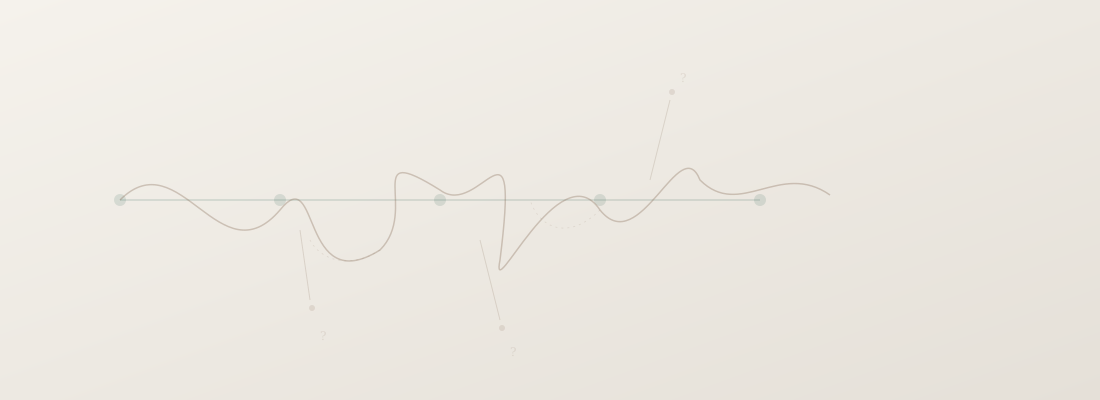
The real journey is recursive, not linear. People circle back. They revisit a brand after forgetting about it. They research obsessively and then buy on impulse from a competitor. They ask a friend, ignore the answer, ask another friend, get the same answer, and then act on it six weeks later as if the idea were their own.
The real journey has exits that nobody mapped. Not exits to a competitor. Exits to inaction. To "I'll think about it," which is the consumer version of "this meeting could have been an email." Most journey maps treat drop-off as a failure of messaging. Often, it's a failure of timing, or relevance, or the fact that the person's kid just started screaming and they closed the tab.
The real journey has entry points you didn't design. Someone mentions your brand at a dinner party. A screenshot of your product shows up in a group chat. A customer uses your tool in a presentation and someone in the audience Googles you afterward. None of these are in the awareness stage of your funnel because your funnel assumes you control how people hear about you. You don't.
Not a better map. A different kind of model entirely. Instead of a linear path, think about a set of moments that can happen in any order, any number of times, with any gap between them. Some are moments you create. Most are moments you can only show up for.
I've started using what I call need-state mapping instead of journey mapping. Rather than plotting a sequence, you identify the four or five states a person might be in when they encounter your brand. Curious but uncommitted. Actively comparing. Returning after a lapse. Advocating to someone else. Each state has its own questions, its own objections, and its own version of what "the right message" sounds like. The sequence between states is irrelevant because there is no sequence. There are just states, and people move between them on their own terms.
The practical difference is significant. A linear journey map produces a content calendar. A need-state model produces a system that works regardless of when or how someone shows up. The content still exists, but it's organized around what the person needs right now, not where you think they should be in your process.
I understand the appeal of the clean map. It makes the work feel organized. It gives the team a shared vocabulary. It puts a complex, chaotic human behavior into a framework that fits on a slide. But the clarity is false, and building strategy on false clarity is how you end up optimizing for a customer who doesn't exist.
Let the journey be messy. Let the model reflect the mess. The brands that win are not the ones with the most elegant funnel on the conference room wall. They're the ones that designed for the person who showed up sideways, out of order, at the worst possible time, and still found something that felt like it was meant for them.