May 2026 · Brand Strategy
Why your rebrand failed before the logo reveal.
Most rebrands die in the research phase. Specifically: because there wasn't one.
May 2026 · Brand Strategy
Most rebrands die in the research phase. Specifically: because there wasn't one.
Right now, somewhere, a company is unveiling a new logo to a conference room. The wordmark is cleaner. The palette is bolder. The mission statement uses the word "reimagine." And eighteen months from now, the CMO who approved it will be explaining to the board why the rebrand didn't move a single number that matters.
The autopsy will blame the agency, the rollout, the budget. But the rebrand didn't fail at the reveal. It failed months earlier, in a phase that got skipped: finding out who the audience actually is.
Every rebrand starts with an implicit theory of the audience. Usually it's leadership's theory, formed years ago, ossified into strategy decks. "Our customer is the hardcore enthusiast." "We're a premium brand for connoisseurs." The rebrand then optimizes the visual identity for that customer.
But brands drift. The customer who found you ten years ago is not the customer keeping the lights on today. I've seen this across outdoor gear, boats, and consumer tech: the audience leadership describes in the kickoff meeting and the audience in the sales data are two different populations. Sometimes they barely overlap.
When I worked on brand foundations for heritage outdoor companies, the research phase routinely surprised the founders themselves. The gear they built for alpinists was being bought by weekend hikers who aspired to alpinism. That's not a smaller story. It's a different story, and it changes everything downstream: the photography, the voice, the retail experience, the logo itself.
Three reasons, and they're all understandable.
First, research feels slow, and rebrands are usually triggered by impatience: a new CEO, a PE acquisition, a competitor's glow-up. The pressure is to show visible change fast, and a logo is the most visible change there is.
Second, research is threatening. If the data says your customer isn't who the founder thinks it is, someone has to walk into a room and say so. Agencies that skip the research phase aren't lazy. They're avoiding a fight their contract doesn't pay them enough to have. (I think that fight is the job. It's most of the job.)
Third, everyone believes they already know. The team lives and breathes the brand; surely they understand its audience. But proximity isn't knowledge. Proximity is bias with a badge.
The current market is a rebrand factory. Private equity buys a tired brand, and a rebrand is the fastest way to signal transformation to the next buyer. The timelines are brutal and the incentive is optics, not accuracy. Which means thousands of companies are about to reskin themselves for an audience nobody verified exists.
If you're inside one of these: the research doesn't have to take long. Stakeholder interviews, a hard look at the actual customer data, a handful of qualitative conversations with real buyers: weeks, not quarters. The point isn't volume. The point is that someone checked.
It's become an agency cliche. Every shop says "strategy before design." Here's the falsifiable version: before anyone opens a design tool, you should be able to answer three questions with evidence, not opinion.
Who buys us now, and why do they say they do? Who do we need to buy us next, and what do they currently believe about us? And what is the one thing we can say that is both true and something no competitor can claim?
If the answers come from a workshop instead of from customers, you don't have a strategy. You have a mood board with a thesis statement.
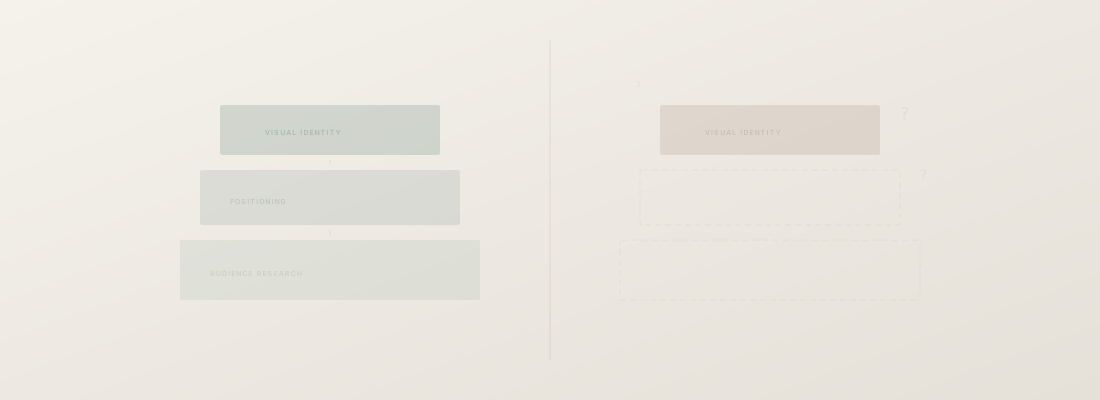
The rebrands that work treat visual identity as the conclusion of an argument: the audience is X, the position is Y, therefore the brand looks and sounds like Z. When the logic chain is real, the logo defends itself. When it isn't, the logo is a Rorschach test, and every stakeholder sees something different in it, and it dies the death of a thousand opinions.
Your rebrand doesn't need a bolder palette. It needs someone willing to find out who's actually buying, before the concrete gets poured.