March 2026 · Brand Strategy
Category design is just positioning with better PR.
The "create your own category" playbook repackages fifty years of positioning theory. What it gets right, what it gets wrong, and why the distinction matters.
March 2026 · Brand Strategy
The "create your own category" playbook repackages fifty years of positioning theory. What it gets right, what it gets wrong, and why the distinction matters.
If you've been in a strategy meeting in the last five years, someone has said the phrase "category of one." Usually it's accompanied by a slide about Salesforce or HubSpot and the implication that if your brand just names a new category, the market will follow. The category design movement has its own books, its own consultancies, and its own conference circuit. What it doesn't have, as near as I can tell, is a new idea.
That sounds dismissive. It isn't meant to be. Not entirely. Category design gets something important right, and I use elements of it in my own work. But the gap between what it claims and what it actually is matters, because that gap is where companies waste money.
In 1981, Al Ries and Jack Trout published Positioning. The core argument: you don't win by being better in an existing category; you win by owning a position in the customer's mind that nobody else occupies. If you can't be first in the category, create a new category you can be first in. Hertz owns "rental cars." Avis couldn't out-Hertz Hertz, so they owned "the one that tries harder."
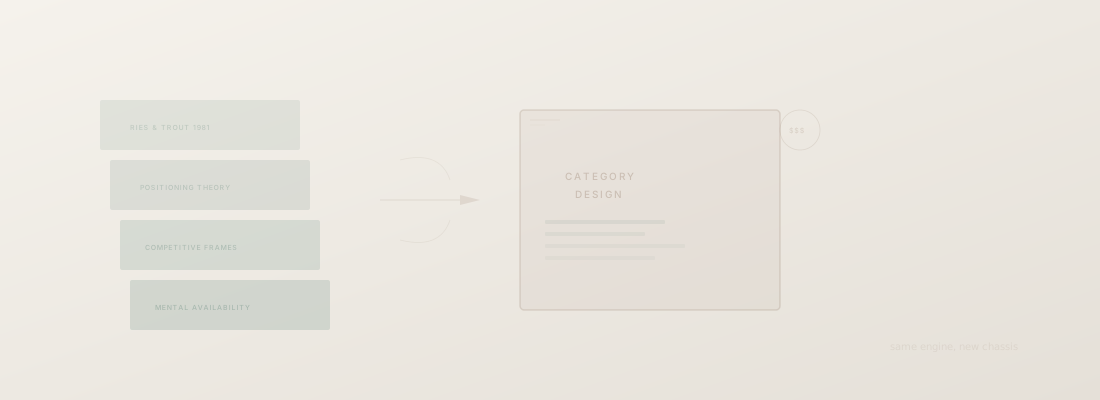
Category design says: don't compete in existing categories, design a new one. If you squint, those are the same sentence with different fonts.
To be fair, the modern category design playbook adds execution rigor that the original positioning literature lacked. The emphasis on aligning product, company, and category simultaneously, what Play Bigger calls the "category ecosystem", is genuinely useful. So is the insistence that category creation is a company-wide effort, not a marketing campaign.
The best category design work I've seen treats the category name as a strategic commitment, not a tagline. When a fintech client I advised stopped calling themselves a "payments platform" and reframed around a category they could own, it changed their product roadmap, their sales narrative, and their hiring profile. That's real. That's strategy doing its job.
The problem is when category design becomes a substitute for the hard work underneath. I've watched companies spend six figures naming a category that their product doesn't yet deserve to anchor. The category name becomes a press release before it becomes a customer reality. The market doesn't adopt categories because you declared one; the market adopts categories because customers find them useful for making decisions.
Salesforce didn't win because it named "cloud CRM." It won because the product delivered something the market needed and the category name gave analysts and buyers a frame to understand it. The category was a consequence of product-market fit, not a cause. When the consultancy deck reverses that causality, companies end up naming categories for products that haven't earned them.
Before you invest in a category design exercise, ask this: can your ideal customer explain the category to a peer without using your brand name? If the category only makes sense with you in the center of it, you don't have a category. You have a tagline. Categories are frames the market uses. Taglines are frames the brand uses. The difference is who's doing the work.
Positioning is still the engine. Category design is a useful chassis. Just don't pay for a new car when you need an alignment.